News

How Do You Specify an 80 kW Dual-Gun DC Fast Charger for Nigeria's EV Market?

2026-09-21 0 Leave me a message

Nigeria's EV market is not short of opportunity. It is short of charging points, compatible connectors, and equipment specified for its grid. This guide explains what buyers should decide before they issue an RFQ — and what to verify before they sign.

Table of Contents

  1. 1. Why Nigeria Is Worth Reading Carefully
  2. 2. What the Charging Landscape Actually Looks Like
  3. 3. Why GB/T Is the De Facto Connector Standard There
  4. 4. Why 80 kW Dual-Gun Is the Practical Configuration
  5. 5. What OCPP 1.6J Actually Buys You
  6. 6. Heat, Dust, Humidity and Grid: Site Conditions First
  7. 7. The Specification Checklist Before You Issue an RFQ
  8. 8. What to Verify During Factory Acceptance Testing
  9. 9. Second-Year Reality: Spare Parts, Warranty and Diagnostics
  10. 10. Common Specification Mistakes
  11. 11. Note From a Recent Order
  12. 12. Frequently Asked Questions
  13. 13. Getting Specification Support
  14. 14. Final Considerations

1. Why Nigeria Is Worth Reading Carefully

Most emerging EV markets are difficult to read from the outside. Nigeria is simpler than most, because the shape of the opportunity is unusually clear: a large population, a large economy, almost no public charging infrastructure, and a government that has begun putting money and tax policy behind closing that gap.

For an engineering contractor, fleet operator or project developer, that combination is not a headline. It is a pipeline. But it also means the first movers are making decisions with very little local precedent to copy — which is exactly where specification mistakes get expensive.

A charging unit is not judged on the day it is commissioned. It is judged on what it does in month fourteen, during a heat wave, on a weak feeder, when a fault appears and the nearest qualified technician is several hours away. Everything in this guide is written from that end of the timeline backwards.

2. What the Charging Landscape Actually Looks Like

Publicly reported figures have consistently pointed in the same direction: a country of well over 200 million people with fewer than one hundred public charging points nationwide, most of them clustered in Lagos and Abuja. Policy responses have included an infrastructure programme reported at roughly USD 1.5 billion targeting around 1,000 charging stations across urban corridors and rural areas, VAT exemptions covering EVs and charging components, and import duty on electric vehicles reported to have been cut to zero. National planning documents such as the National Energy Transition Plan have also set out long-term targets for electrifying the national fleet.

(Figures above reflect publicly reported policy positions as of 2026; verify current figures with your local partner before finalising a business case.)

Two things follow from this for anyone specifying equipment:

  • The charging map is nearly empty. A network builder is not competing for share in a mature market; they are selecting locations and standards that will define the market for years.
  • Incentives can change. A procurement decision should be defensible even if a tax exemption disappears, which argues for equipment whose value rests on utilisation and uptime rather than on the incentive itself.

3. Why GB/T Is the De Facto Connector Standard There

This is the single most important specification decision in the Nigerian market, and it surprises buyers who assume CCS2 is the default everywhere outside China.

The overwhelming majority of electric vehicles imported into Nigeria are Chinese-built. Those vehicles arrive with GB/T inlets. A charging station fitted with CCS2 cables will sit in Lagos surrounded by vehicles it cannot serve.

This is not a preference question and not a future-proofing question. It is a match-the-installed-base question, and getting it wrong disables the asset on day one.

Multi-standard configurations exist and are worth considering when a single site must serve a mixed fleet — for example GB/T on one gun and CCS2 on the other — but for a network whose demand is overwhelmingly Chinese-built vehicles, specifying GB/T across both guns is usually the safer default. Ask what the connector configuration costs to change later; if the answer is "a new cable assembly", that is manageable. If it involves reconfiguring the power modules, it is not.

4. Why 80 kW Dual-Gun Is the Practical Configuration

Power sizing in an emerging market is a balance between session time and grid capacity, and 80 kW with two guns tends to sit at the useful intersection for urban and corridor sites.

Configuration What it does well Where it becomes a problem
Single gun, 60–80 kW Simplest installation, lowest grid requirement One vehicle occupies the bay for the whole session; no revenue while a second vehicle queues
Dual gun, 80 kW (shared) Two vehicles served from one footprint and one grid connection; intelligent power allocation gives the full rating to one vehicle when only one is connected Requires the power-distribution logic to be genuinely tested, not just described
120 kW and above Shortest single-vehicle session times Often needs a grid upgrade that costs more than the charger; liquid-cooled cables add handling and maintenance considerations

The engineering point behind dual-gun is not "twice the power". It is that a single set of power electronics, one enclosure and one grid connection can serve two bays. In markets where grid capacity is expensive or slow to obtain, that ratio matters more than the headline rating.

Two features are worth confirming early:

  • How power is allocated when two vehicles are connected — some units split evenly, some allocate by priority or battery state, some are configurable. Behaviour under real load is more informative than the datasheet phrase.
  • What happens when one gun faults during a dual session — the desirable answer is that the surviving gun continues operating and the event is logged remotely.

5. What OCPP 1.6J Actually Buys You

OCPP is often listed as a checkbox. It is worth being specific about why it earns that place.

OCPP 1.6J is the version with the widest field-proven backend compatibility. Practically, it means:

  • The charger can report state, session data and fault conditions to a management backend without a proprietary gateway.
  • You are not locked to the manufacturer's own software to run a commercial site — tariffs, user accounts and access control live in your backend.
  • Diagnostics can begin before anyone travels to the site, which is the difference between a technician driving out with the right module and driving out twice.

Support for 2.0.1 alongside 1.6J adds headroom for newer backends. If you already run or intend to run a specific CPMS, tell the manufacturer before you order; protocol compatibility is cheaper to resolve on paper than in the field.

6. Heat, Dust, Humidity and Grid: Site Conditions First

Nigeria's coastal and southern regions combine heat, humidity and salt-laden air; northern and inland conditions add dust and higher ambient temperatures. Grid supply can be unstable and may depend on generator backup at some sites.

Before finalising a specification, confirm the following explicitly, in writing, with the manufacturer:

  • Operating ambient range. For coastal tropical sites, verify the declared upper limit and whether output de-rates above it.
  • Ingress and impact rating. A floor-mounted unit in an unsheltered bay needs a meaningful IP rating and impact protection, not a generic "outdoor" claim.
  • Corrosion protection. Coastal installations warrant galvanised enclosures with appropriate coating, and conformal-coated PCBs where humidity and salt exposure are expected.
  • Input tolerance. If the site runs on backup generation, the acceptable input voltage and frequency window, plus behaviour on transfer, is a specification item, not an afterthought.
  • Foundation and drainage. Standing water around a floor-mounted cabinet is a maintenance problem that no amount of IP rating solves cheaply.

7. The Specification Checklist Before You Issue an RFQ

Putting these items into the enquiry itself — rather than discovering them during commissioning — is what separates a clean project from a slow one.

Item Why it matters What to ask for
Connector configuration Vehicle compatibility decides utilisation GB/T on both guns, or mixed GB/T + CCS2; confirm change cost
Output voltage range Must cover the vehicles actually in the market Declared DC output window and its regulation behaviour
Power allocation logic Determines throughput at busy sites Behaviour when one and two vehicles are connected
Grid requirement Often the hidden project cost Required input capacity, phases, tolerance window
De-rating behaviour Protects your business case At what ambient temperature output is reduced, and by how much
Enclosure rating Site-dependent longevity IP and IK rating, coating specification for coastal sites
Protocol and backend Future flexibility OCPP version support, tested backend partners
Certification documentation Import clearance CE documentation package; whether the destination market requires anything beyond it
Authentication and payment Revenue model RFID / app support, backend handling per gun
Spare parts proposal Uptime after year one Recommended module and consumable set, sized to site count and service distance

8. What to Verify During Factory Acceptance Testing

This is the part most buyers skip, and it is where a specification either becomes real or stays aspirational. Whether you travel or appoint a third-party inspector, the following are worth witnessing rather than reading:

  1. Full-load operation at declared output — sustained, not momentary, with the cooling system given time to stabilise.
  2. Dual-gun behaviour under simultaneous load — including unequal demand, and what the allocation logic does.
  3. Fault injection — induce or simulate a representative fault and confirm the unit logs it, reports it, and either recovers or fails safely.
  4. Protection functions — over-voltage, over-current, insulation monitoring and emergency stop, each actually triggered.
  5. Environmental checks appropriate to the destination — at minimum, insulation resistance and visual inspection of coating and sealing after any environmental testing performed.
  6. Connector and cable handling — physical condition, strain relief, and connector fit against the actual vehicle standards in your market.
  7. Documentation completeness — what ships with the unit, what supports certification, and what is required for the importer's conformity process.

A supplier who is comfortable being watched through this list tells you something useful. A supplier who would rather send a test report instead is also telling you something.

9. Second-Year Reality: Spare Parts, Warranty and Diagnostics

The purchase price is the visible part of the cost. The rest shows up later, and it is largely determined by decisions made at order time.

  • Spare parts strategy. Agree a recommended package up front, sized against the number of sites and the distance to each. Waiting for the first failure to discover what should have shipped with it is the most common avoidable downtime in remote deployments.
  • Modules versus whole units. Modular architectures — where the power conversion modules that realistically fail can be swapped on site — convert a multi-week outage into a same-day repair. Confirm who is expected to perform that swap.
  • Remote diagnostics. This is what makes the distance problem manageable: knowing what failed before anyone leaves.
  • Warranty wording versus recovery path. The clause that matters is not the duration; it is how quickly a replacement part reaches your site and who fits it.

10. Common Specification Mistakes

A short list of what actually goes wrong:

  • Specifying the connector for the market you hope to have rather than the vehicles you have today. Utilisation punishes optimism immediately.
  • Sizing for session time instead of grid reality. The most expensive component is often the transformer upgrade nobody budgeted for.
  • Assuming "IP rated" means "coastal rated". Corrosion is the dominant failure mode in tropical saline environments, and it is addressed by materials and coating, not a rating alone.
  • Omitting de-rating behaviour from the specification. A charger that meets its rating at 25 °C tells you nothing about a 42 °C afternoon.
  • Treating OCPP as a checkbox. Confirm protocol version compatibility against the specific backend you intend to run, before contract.
  • Leaving certification to be discovered at the border. The documentation package is a deliverable; request it as one.

11. Note From a Recent Order

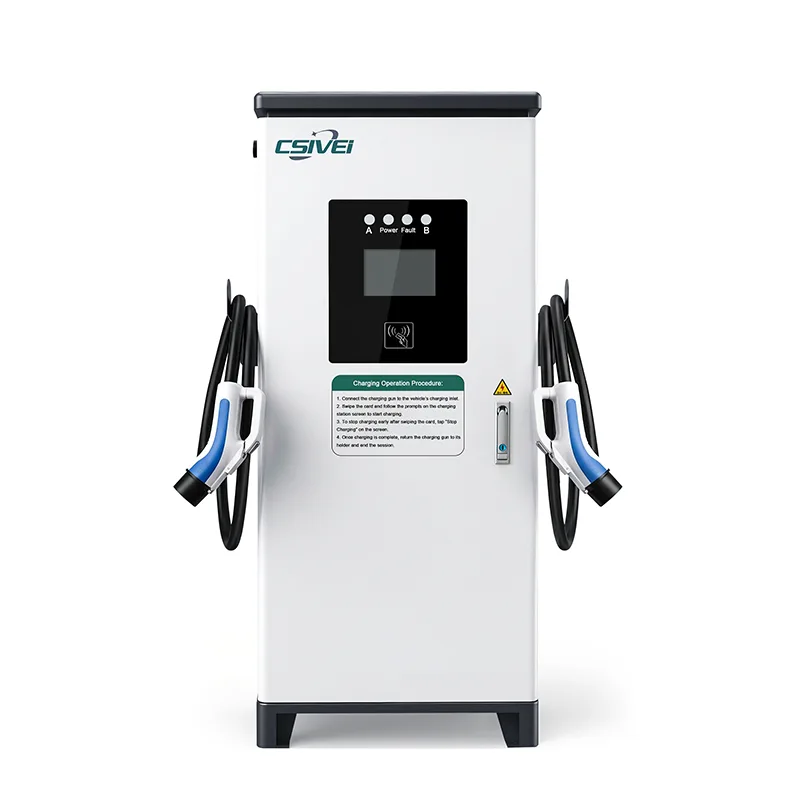
A Nigerian engineering contractor working across multiple public and private construction projects specified an 80 kW dual-gun DC charging station with GB/T connectors and OCPP 1.6.

Two things about that order are worth noting. The connector decision was not a preference — it matched the vehicle mix importing into their market, which is the correct engineering basis for the choice. And the configuration was confirmed during a production-line inspection rather than accepted from a quotation, which is how specification turns into hardware.

The broader pattern is familiar across emerging markets: the buyers who move fastest on paperwork are rarely the ones still operating comfortably in year two.

12. Frequently Asked Questions

Should I specify GB/T even if my own fleet uses CCS2 today?

Match the vehicles you will serve. If your own fleet is CCS2 but the public vehicles around your site are GB/T, a mixed configuration on one unit may serve both. Confirm whether connector configuration can be changed later and at what cost.

Is 80 kW enough, or should I go higher?

Higher ratings shorten session times but frequently require grid capacity that costs more than the additional electronics. Establish what your grid connection actually supports first; that answer usually picks the rating for you.

Do I really need OCPP if I plan to use the manufacturer's own software?

You may not initially. You will want it the moment you add a second site, change billing provider, or want fault visibility without a site visit.

What should ship in the box besides the charger?

Ask specifically: documentation package, certification support files, connector holsters and cables, and a spare parts recommendation sized to your number of sites.

Can my own technicians do repairs?

It depends on the architecture. Modular units with hot-swappable modules are designed for exactly that. Ask what interventions the manufacturer considers field-serviceable and what voids warranty.

How long does a purchase decision usually take after inspection?

It varies with the operator. In markets where the constraint is grid availability rather than equipment availability, the inspection is rarely the slow part.

13. Getting Specification Support

Csivei manufactures DC fast charging stations including a dual-gun standing DC EV charger with multi-standard support, alongside the industrial equipment behind charging sites — VFD control panels, distribution and control enclosures.

If you are preparing an enquiry, the most useful information you can send is your site conditions rather than your required power rating: ambient range, grid capacity and stability, vehicle mix, expected daily sessions, and how far your nearest technician is. Those answers determine the specification more reliably than any target number.

Send your site conditions through the inquiry form and we will respond with a configuration proposal.

14. Final Considerations

Emerging EV markets reward operators who get two things right early: matching the connector to the vehicles that are actually on the road, and treating uptime as a specification rather than a hope.

Neither decision is glamorous, and neither shows up in a headline cost comparison. Both show up clearly in the utilisation figures a year after commissioning — which is the only place a charging project is finally evaluated.

Specify for that date, not for the order form.

Related News
Leave me a message
X
We use cookies to offer you a better browsing experience, analyze site traffic and personalize content. By using this site, you agree to our use of cookies. Privacy Policy
RejectAccept